Green Volt Floating Offshore Wind Project Secures Key Planning Approval
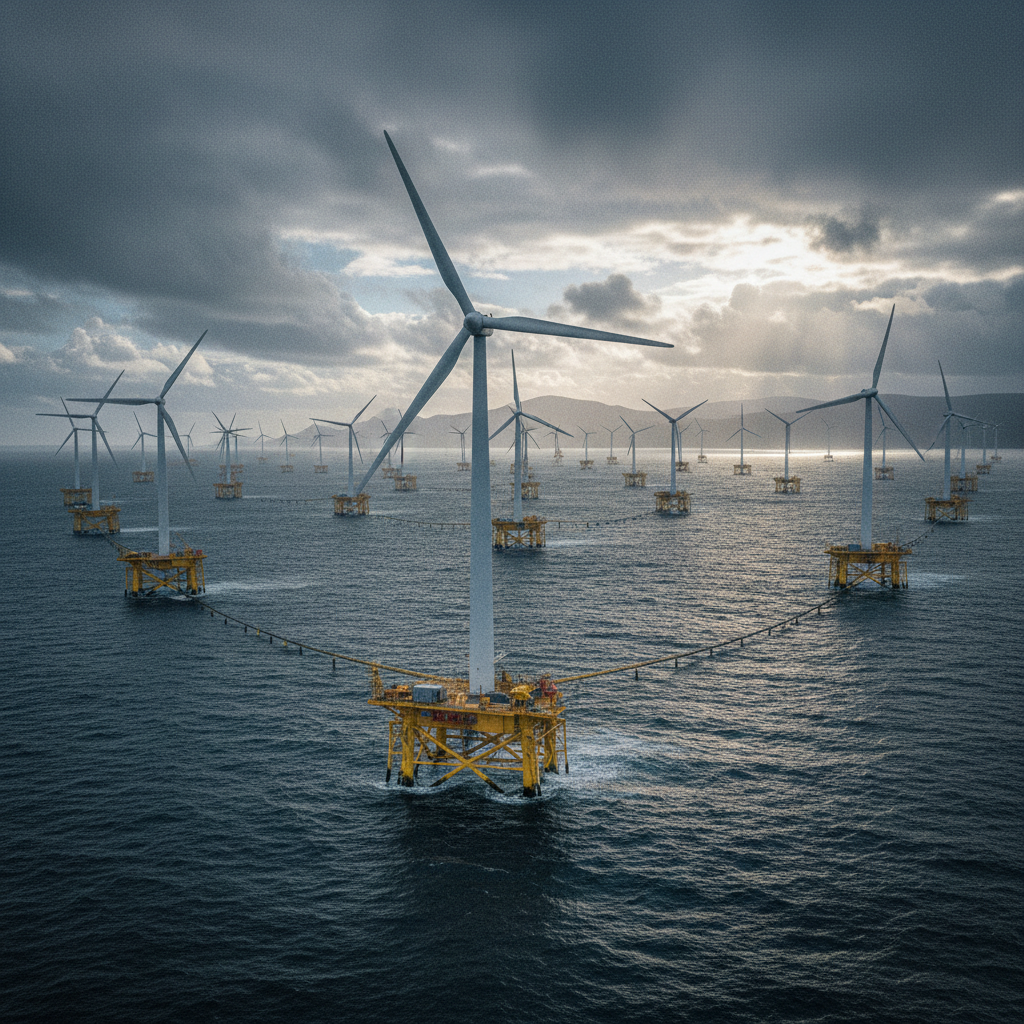
The 560MW Green Volt floating offshore wind project, developed by Flotation Energy and Vårgrønn, has received offshore planning approval, marking a significant milestone for UK floating wind technology.
Green Volt Floating Wind Project Gains Offshore Planning Approval
Edinburgh, Scotland – The ambitious 560MW Green Volt floating offshore wind project, a collaborative venture between developers Flotation Energy and Vårgrønn, has successfully secured offshore planning approval. This significant regulatory clearance marks a pivotal step for the project, which aims to provide renewable electricity to both offshore oil and gas platforms and the wider UK grid.
The project, positioned as part of Crown Estate Scotland’s Innovation and Targeted Oil & Gas (INTOG) leasing round, is designed to replace traditional natural gas and diesel power generation on offshore installations. Upon completion, Green Volt is slated to feature up to 35 floating wind turbines, generating a substantial 560MW of clean energy capacity.
Scotland's First Minister, Humza Yousaf, lauded the approval, stating, “It is great news that we have consented the first project in the Crown Estate Scotland’s Innovation and Targeted Oil and Gas (INTOG) leasing round – this is a significant milestone which will help secure Scotland’s place at the forefront of floating wind technology.” He further emphasised Scotland's commitment to delivering robust consents for renewable projects, ensuring appropriate development in suitable locations and timeframes.
Green Volt is equally owned by Flotation Energy and Vårgrønn, with the latter being a joint venture between Plenitude (Eni) and HitecVision. Olav Hetland, CEO at Vårgrønn, highlighted the project's pioneering role, remarking, “With Green Volt being Europe’s first commercial-scale floating wind project, achieving offshore consent for the project marks an important moment for the whole offshore wind industry.” Hetland underscored the project’s importance as a transitional development, bridging smaller-scale initiatives with future gigawatt-sized developments and fostering the scaling up of new technologies within the supply chain.
Advancing Floating Wind Technology
The potential of floating offshore wind in the UK has long been a subject of discussion, primarily due to the nation's advantageous geographical position, offering both strong wind resources and extensive offshore sites. This technology is particularly crucial for accessing deeper waters where traditional fixed-bottom turbines are not feasible, thereby unlocking vast new areas for renewable energy generation.
Recent research underscores the economic benefits associated with this burgeoning sector. In February 2024, the Crown Estate released a study, 'The Celtic Sea Blueprint,' indicating that the floating offshore wind opportunity in the Celtic Sea alone could contribute up to £1.4 billion to the UK economy. Conducted by Lumen Energy and Environment, the independent study detailed that the development of new floating wind farms off the coasts of South Wales and South West England could generate up to 5,300 new jobs, fostering a skilled workforce in local regions and supporting the growth of the renewable energy sector.
Specifically, the first three floating offshore wind farms planned for the Celtic Sea are projected to be among the largest globally, with a combined generation capacity of up to 4.5GW of electricity, according to The Crown Estate.
Scotland's Renewable Energy Leadership
Scotland continues to distinguish itself as a key region within the UK with substantial potential for wind energy generation. This is exemplified by various initiatives, including a 14-turbine wind farm under construction in the Scottish Borders, which is set to become Britain’s largest people-owned renewable energy project. This particular site is expected to power over 50,000 homes and generate approximately 145GWh annually, showcasing the breadth of wind energy development across the nation.
The Green Volt project’s approval, alongside other consented floating and tidal energy projects ahead of the Allocation Round 6 (AR6) application window, reinforces Scotland's strategic position in pioneering renewable energy technologies. These developments are integral to the UK's broader decarbonisation efforts and its ambition to achieve net-zero emissions, with floating offshore wind playing an increasingly vital role in diversifying the energy mix and bolstering energy security.
What this means for asset owners and insurers
- Complex Project Risk: Floating offshore wind projects involve innovative and complex engineering, requiring specialised insurance coverage for design, construction, installation, and operation, including risks associated with novel floating foundations and deep-water moorings.
- Enhanced Marine & Weather Exposure: Assets located in deeper, more exposed offshore environments face heightened risks from severe weather events, requiring robust property damage, business interruption (BI), and marine cargo/transit insurance provisions.
- Supply Chain & Technology Risks: As a developing technology, the supply chain for floating wind components and specialised vessels may present unique procurement and operational risks, influencing delay in start-up (DSU) and contingent business interruption (CBI) coverages.
- Environmental and Third-Party Liabilities: The installation and operation of large-scale floating wind farms in sensitive marine ecosystems necessitate comprehensive public liability (PL) and environmental impairment liability (EIL) insurance to cover potential ecological impacts or third-party claims.
Source: solarpowerportal.co.uk